
Happily Arrived
- SaaS B2B
AI-Powered Event Onboarding
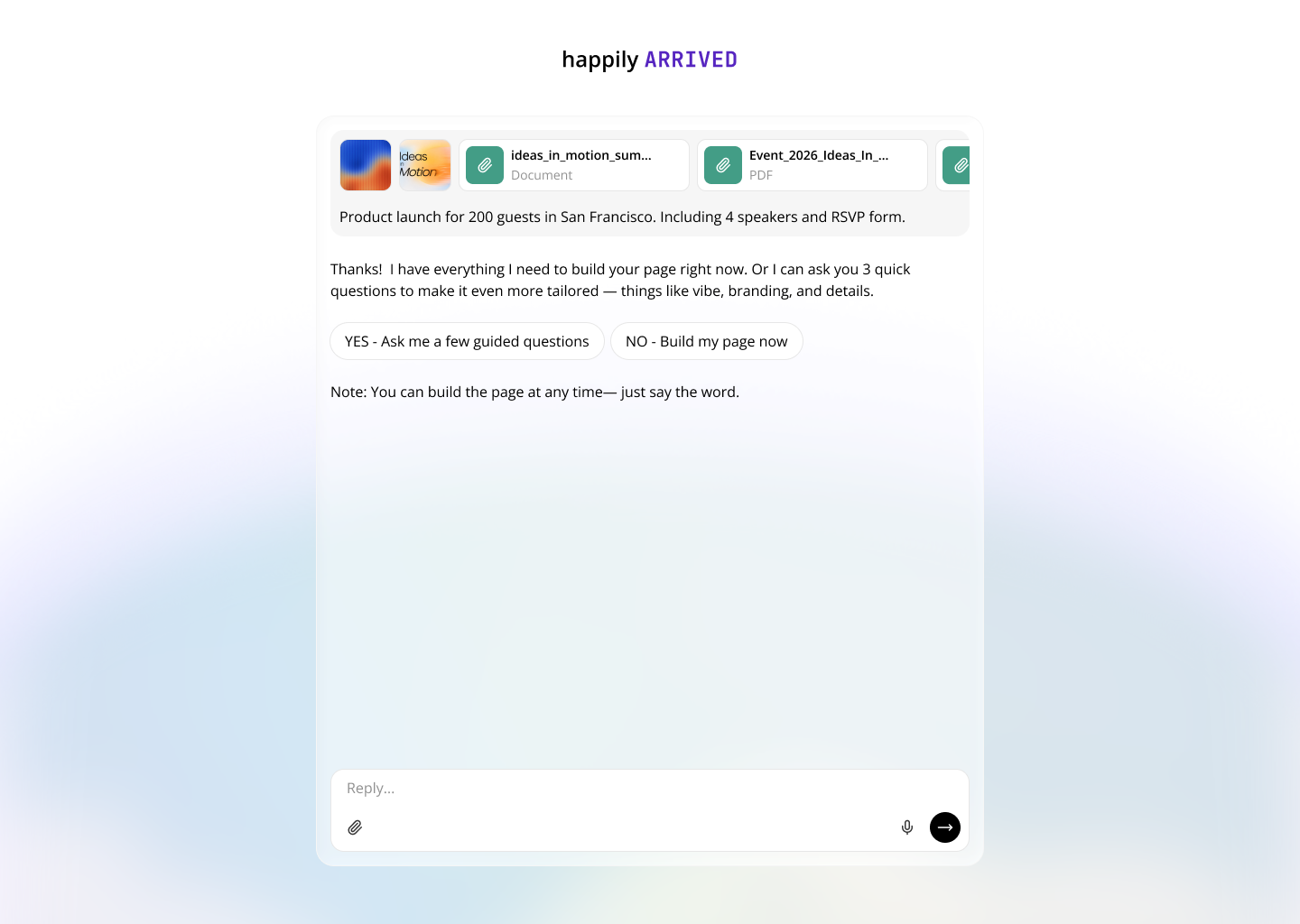
Introducing AI onboarding reduces time-to-value on how event creators start an event page, from a multi-step setup form into a single AI conversation. Describe your event, upload a brief, or forward an old invite, and Arrived AI builds a fully branded, ready-to-publish event page in the same flow.
ROLE
Product Designer
DURATION
4 weeks

Results Snapshot
25%
Increase to published event
Previously from 55% draft → live site
~10 mins
Estimated time to publish
Previously around 45 mins to 1 hour
85%
Output AI-inferred vs. manual
Event pages mostly build from AI
The Problem
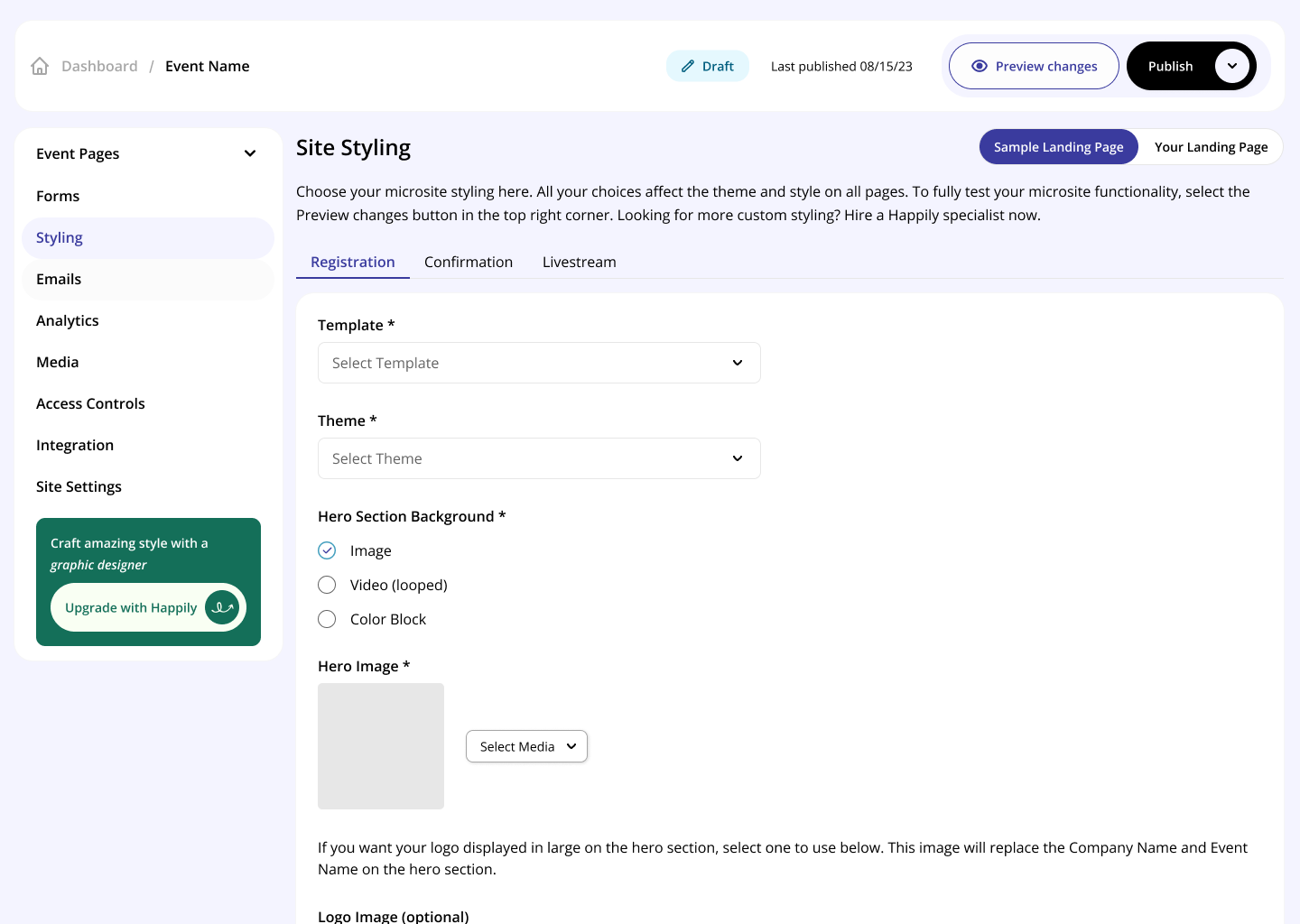
How might we help event organizers start their event page without making them fill out every form field before they’ve even seen what they’re building?
First-time users hit real friction:
- A blank dashboard with no starting point, making the first ten minutes the most likely place to abandon the flow entirely
- Uncertainty about which fields actually mattered vs. which could be skipped, leading to over-thinking simple decisions
- No visibility into what the system assumed on a user's behalf, if content was pre-filled anywhere, users had no way to know whether to trust it
The Solution
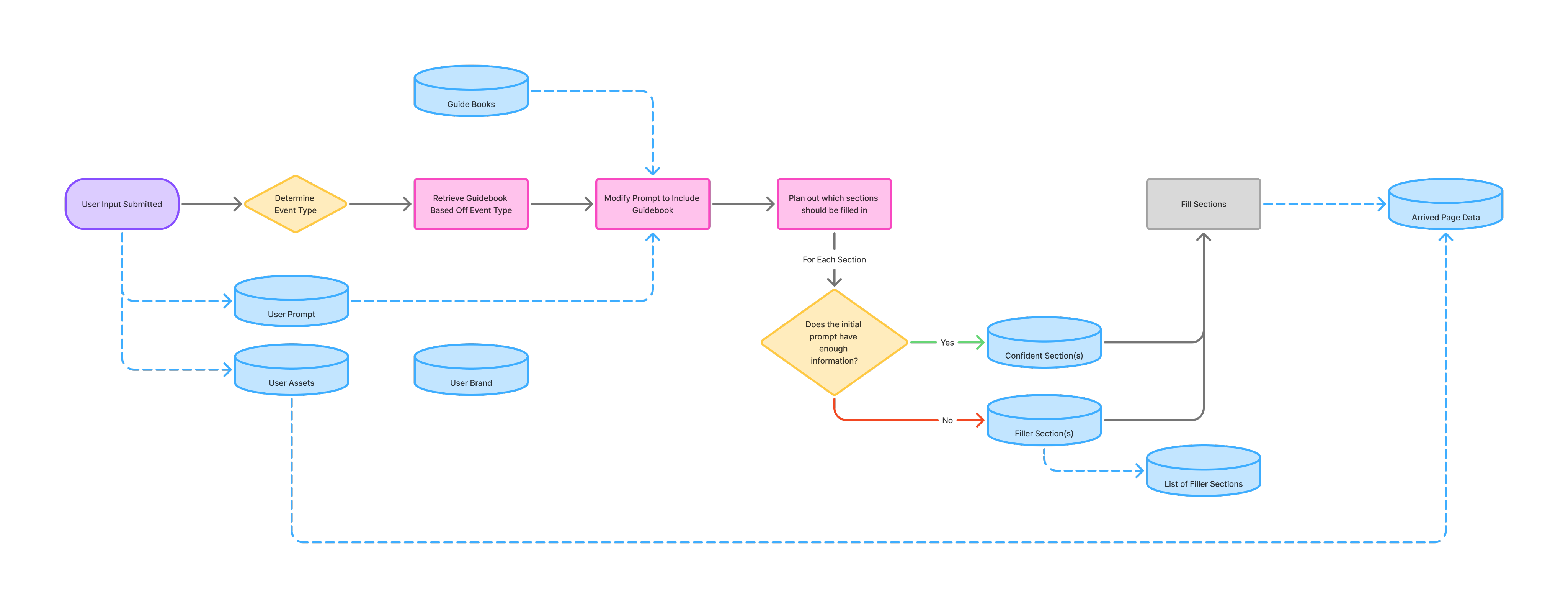
Shaping an agentic, conversational experience that surfaces AI-powered insights to less-technical customers, not adding AI as a feature, but rethinking the interaction model itself:
- A single prompt (or a few guided questions) that generates a full draft event site instead of a blank canvas
Research & Discovery
To validate these needs, I ran 5 moderated sessions with event producers and 3 with Happily specialists, then mapped every event type and data point the AI would need to infer versus ask for directly. That mapping uncovered a few consistent patterns:
- Producers wanted a working page immediately, even if some sections were placeholder content
- Specialists needed the AI’s guesses to be easy to spot and override, not silently accepted
- Most first-time users didn’t know what information an event page even needed until they saw one
THE GOAL
Collect only what the AI can’t reasonably infer, and infer everything else. So most users can go from a blank prompt to a finished page without seeing a form field.
Design Process
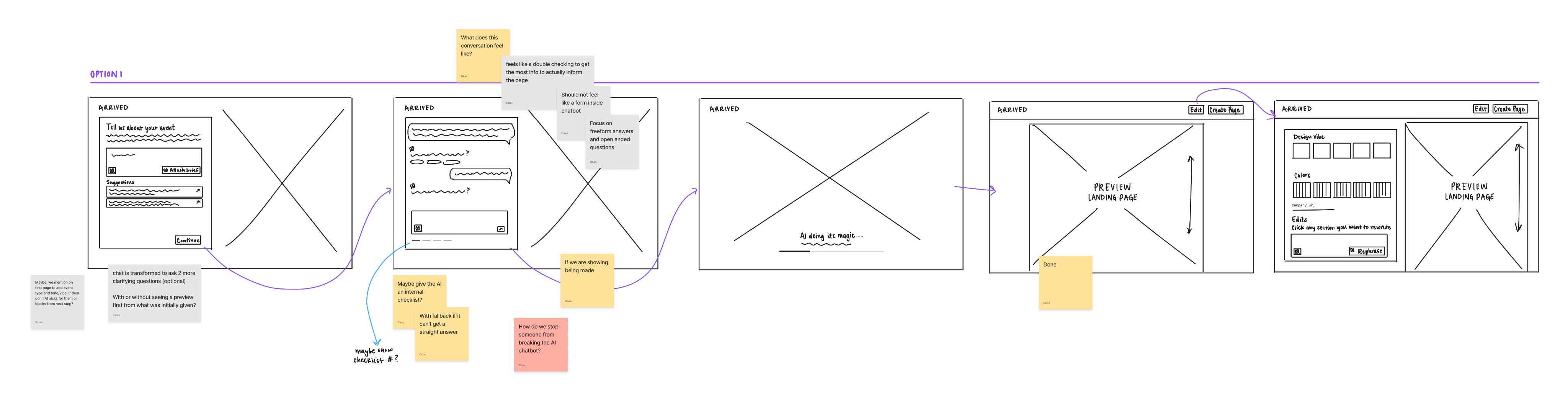
Started with low-fidelity wireframes to test the core prompt-to-preview concept, then iterated on how much generated content to mark as "inferred". This was also the first project where I built AI tools into my own process, not just into the product.
- I used Claude Code for prototyping to quickly spin up and test multiple onboarding flow variations side by side
- Different prompt structures, different confidence-tag placements
- Which let me iterate on the underlying conversational structure itself, not just the visual layer, faster than traditional wireframing alone would have allowed
Testings & Iterations
Part I - CONCEPT TESTING (PROMPT-TO-PREVIEW)
Key Insight: Users trusted the AI-generated draft more when they could see, section by section, what was inferred vs. specified → this directly shaped the "inferred" tag system in the final design.
Part II - GUIDED VS. FAST-PATH TESTING
Key Insight: Confident, repeat-minded users felt slowed down by mandatory guided questions → this led to offering "Build Now" as a parallel fast path instead of forcing everyone through the same sequence.
Design Decisions & Considerations
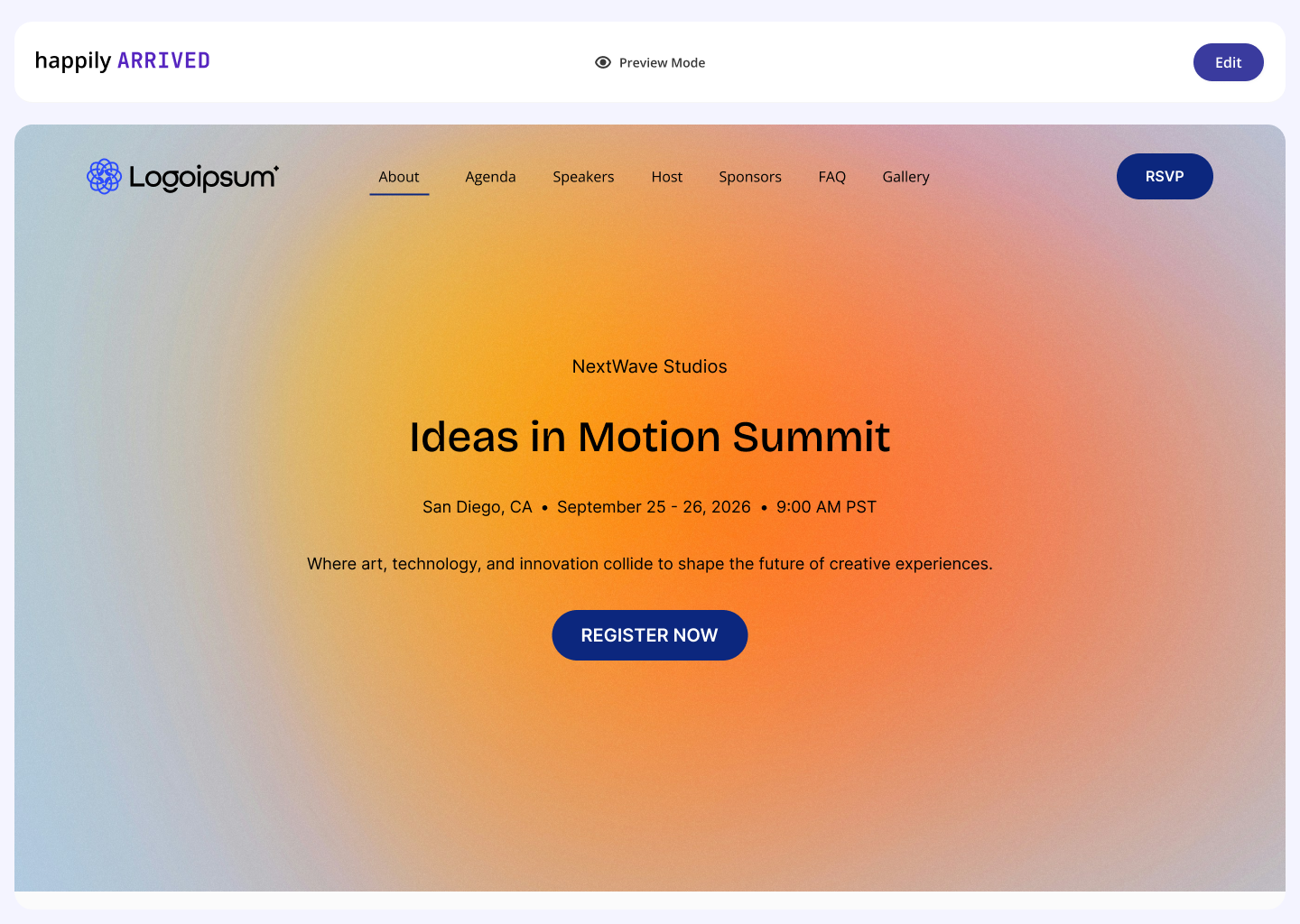
- Prompt-to-Preview Instead of a Blank Canvas
- First-time users had no reference point for what a "good" event site looked like, so a blank dashboard read as intimidating rather than flexible
- A single prompt, or a few guided questions, generates a full draft site instantly
- Gave people something concrete to react to and edit, instead of asking them to create from nothing
- Inferred Content Tags
- Any AI-generated content the user didn't explicitly provide is visibly tagged "inferred," with one-click edit or confirm
- Testing showed trust in the AI draft depended entirely on transparency about what was guessed vs. specified, this closed that gap directly
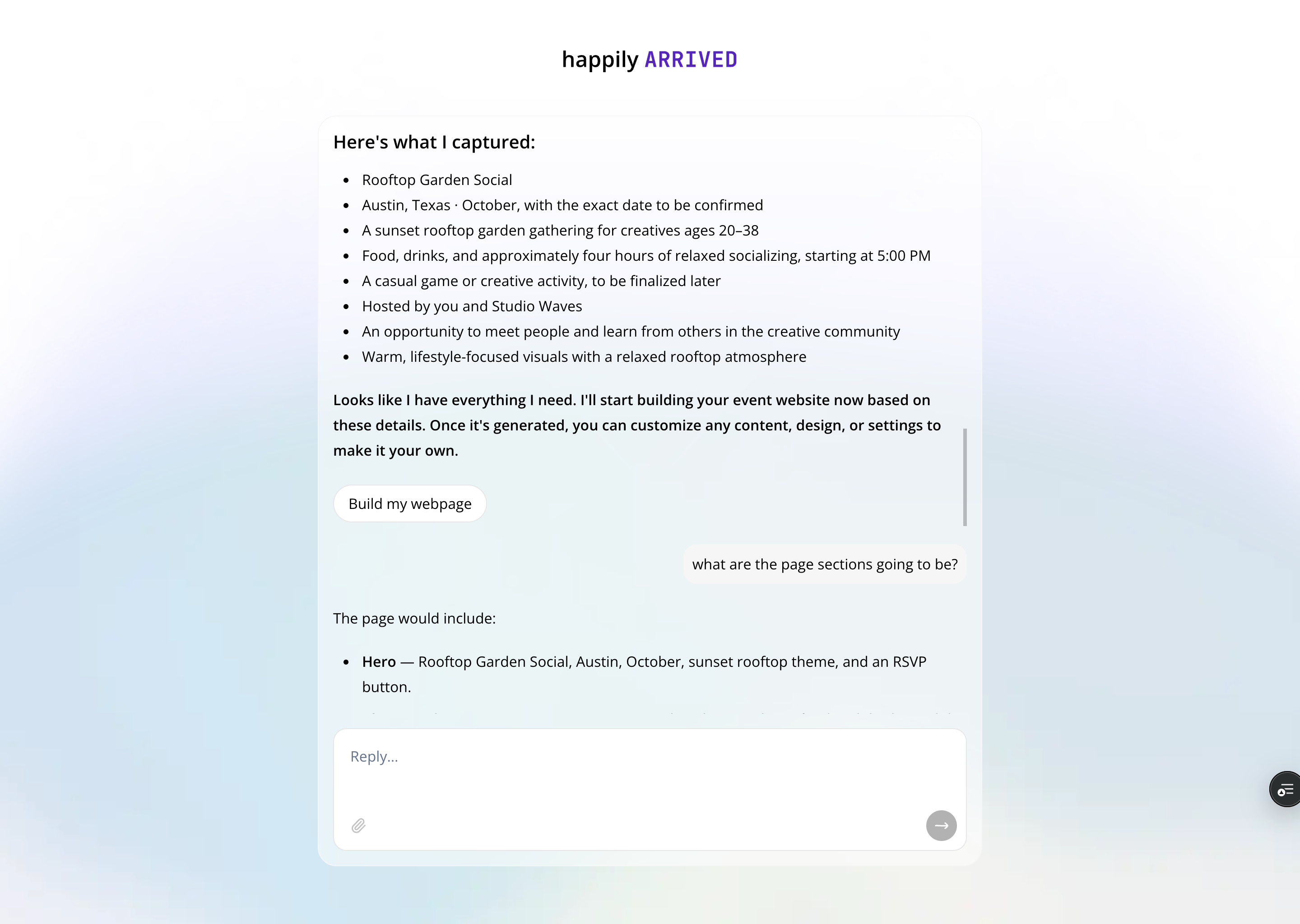
- Build Now vs. Guided Path Decision
- Confident users can skip straight to a generated draft ("Build Now"); less-confident users can opt into a guided question flow instead
- Testing (Part II) showed a single mandatory path either overwhelmed cautious users or slowed down confident ones
- Offering both let each group move at their own pace
Project Impact
Faster Time to Preview & Publish
Went from a blank prompt to a full generated site preview in under 90 seconds, on average
Higher Onboarding Adoption
Lifted the amount of new users that complete the setup of a event website
Reflections & Next Steps
Transparency Builds Trust in AI Output
Users didn't need the AI to be perfect. They needed to always know what it had guessed, so they could decide what to double-check.
One Path Doesn't Fit Every User
Confident and cautious users needed genuinely different flows, not just different amounts of hand-holding within the same one.
Designing for AI Structures Is Its Own Discipline
Uncertainty, confidence, and inferred content aren't edge cases in an agentic product, they're the core interaction model. This project pushed me to design for what a system doesn't know yet, not just what it does.
Thanks for stopping by, want to get in touch?
I’d love to chat and connect with you!

© Made with 💚+ 🍵︎ by Sarah Tomaszewski 2026
Home
About
Resume
Happily Arrived
- SaaS B2B
AI-Powered Event Onboarding
Introducing AI onboarding reduces time-to-value on how event creators start an event page, from a multi-step setup form into a single AI conversation. Describe your event, upload a brief, or forward an old invite, and Arrived AI builds a fully branded, ready-to-publish event page in the same flow.
ROLE
Product Designer
DURATION
4 weeks

Results Snapshot
25%
Increase to published event
Previously from 55% draft → live site
~10 mins
Estimated time to publish
Previously around 45 mins to 1 hour
85%
Output AI-inferred vs. manual
Event pages mostly build from AI
The Problem
How might we help event organizers start their event page without making them fill out every form field before they’ve even seen what they’re building?
First-time users hit real friction:
- A blank dashboard with no starting point, making the first ten minutes the most likely place to abandon the flow entirely
- Uncertainty about which fields actually mattered vs. which could be skipped, leading to over-thinking simple decisions
- No visibility into what the system assumed on a user's behalf, if content was pre-filled anywhere, users had no way to know whether to trust it
The Solution
Shaping an agentic, conversational experience that surfaces AI-powered insights to less-technical customers, not adding AI as a feature, but rethinking the interaction model itself:
- A single prompt (or a few guided questions) that generates a full draft event site instead of a blank canvas
Research & Discovery
To validate these needs, I ran 5 moderated sessions with event producers and 3 with Happily specialists, then mapped every event type and data point the AI would need to infer versus ask for directly. That mapping uncovered a few consistent patterns:
- Producers wanted a working page immediately, even if some sections were placeholder content
- Specialists needed the AI’s guesses to be easy to spot and override, not silently accepted
- Most first-time users didn’t know what information an event page even needed until they saw one
THE GOAL
Collect only what the AI can’t reasonably infer, and infer everything else. So most users can go from a blank prompt to a finished page without seeing a form field.
Design Process
Started with low-fidelity wireframes to test the core prompt-to-preview concept, then iterated on how much generated content to mark as "inferred". This was also the first project where I built AI tools into my own process, not just into the product.
- I used Claude Code for prototyping to quickly spin up and test multiple onboarding flow variations side by side
- Different prompt structures, different confidence-tag placements
- Which let me iterate on the underlying conversational structure itself, not just the visual layer, faster than traditional wireframing alone would have allowed
Testings & Iterations
Part I - CONCEPT TESTING (PROMPT-TO-PREVIEW)
Key Insight: Users trusted the AI-generated draft more when they could see, section by section, what was inferred vs. specified → this directly shaped the "inferred" tag system in the final design.
Part II - GUIDED VS. FAST-PATH TESTING
Key Insight: Confident, repeat-minded users felt slowed down by mandatory guided questions → this led to offering "Build Now" as a parallel fast path instead of forcing everyone through the same sequence.
Design Decisions & Considerations
- Prompt-to-Preview Instead of a Blank Canvas
- First-time users had no reference point for what a "good" event site looked like, so a blank dashboard read as intimidating rather than flexible
- A single prompt, or a few guided questions, generates a full draft site instantly
- Gave people something concrete to react to and edit, instead of asking them to create from nothing
- Inferred Content Tags
- Any AI-generated content the user didn't explicitly provide is visibly tagged "inferred," with one-click edit or confirm
- Testing showed trust in the AI draft depended entirely on transparency about what was guessed vs. specified, this closed that gap directly
- Build Now vs. Guided Path Decision
- Confident users can skip straight to a generated draft ("Build Now"); less-confident users can opt into a guided question flow instead
- Testing (Part II) showed a single mandatory path either overwhelmed cautious users or slowed down confident ones
- Offering both let each group move at their own pace
Project Impact
Faster Time to Preview & Publish
Went from a blank prompt to a full generated site preview in under 90 seconds, on average
Lower Setup Effort
Lifted the amount of new users that complete the setup of a event website
Reflections & Next Steps
Transparency Builds Trust in AI Output
Users didn't need the AI to be perfect. They needed to always know what it had guessed, so they could decide what to double-check.
One Path Doesn't Fit Every User
Confident and cautious users needed genuinely different flows, not just different amounts of hand-holding within the same one.
Designing for AI Structures Is Its Own Discipline
Uncertainty, confidence, and inferred content aren't edge cases in an agentic product, they're the core interaction model. This project pushed me to design for what a system doesn't know yet, not just what it does.
Thanks for stopping by, want to get in touch?
I’d love to chat and connect with you!
© Made with 💚+ 🍵︎ by Sarah Tomaszewski 2026
Home
About
Resume
Happily Arrived
- SaaS B2B
AI-Powered Event Onboarding
Introducing AI onboarding reduces time-to-value on how event creators start an event page, from a multi-step setup form into a single AI conversation. Describe your event, upload a brief, or forward an old invite, and Arrived AI builds a fully branded, ready-to-publish event page in the same flow.
ROLE
Product Designer
DURATION
4 weeks

Results Snapshot
25%
Increase to published event
Previously from 55% draft → live site
~10 mins
Estimated time to publish
Previously around 45 mins to 1 hour
85%
AI-inferred vs. manual input
Event pages mostly build from AI
The Problem
How might we help new users go from "I need an event site" to a working draft, without forcing everyone through a blank dashboard on day one?
First-time users hit real friction:
- A blank dashboard with no starting point, making the first ten minutes the most likely place to abandon the flow entirely
- Uncertainty about which fields actually mattered vs. which could be skipped, leading to over-thinking simple decisions
- No visibility into what the system assumed on a user's behalf, if content was pre-filled anywhere, users had no way to know whether to trust it
The Solution
Shaping an agentic, conversational experience that surfaces AI-powered insights to less-technical customers, not adding AI as a feature, but rethinking the interaction model itself:
- A single prompt (or a few guided questions) that generates a full draft event site instead of a blank canvas
Research & Discovery
To validate these needs, I ran 5 moderated sessions with event producers and 3 with Happily specialists, then mapped every event type and data point the AI would need to infer versus ask for directly. That mapping uncovered a few consistent patterns:
- Producers wanted a working page immediately, even if some sections were placeholder content
- Specialists needed the AI’s guesses to be easy to spot and override, not silently accepted
- Most first-time users didn’t know what information an event page even needed until they saw one
THE GOAL
Collect only what the AI can’t reasonably infer, and infer everything else. So most users can go from a blank prompt to a finished page without seeing a form field.
Design Process
Started with low-fidelity wireframes to test the core prompt-to-preview concept, then iterated on how much generated content to mark as "inferred". This was also the first project where I built AI tools into my own process, not just into the product.
- I used Claude Code for prototyping to quickly spin up and test multiple onboarding flow variations side by side
- Different prompt structures, different confidence-tag placements
- Which let me iterate on the underlying conversational structure itself, not just the visual layer, faster than traditional wireframing alone would have allowed
Testings & Iterations
Part I - CONCEPT TESTING (PROMPT-TO-PREVIEW)
Key Insight: Users trusted the AI-generated draft more when they could see, section by section, what was inferred vs. specified → this directly shaped the "inferred" tag system in the final design.
Part II - GUIDED VS. FAST-PATH TESTING
Key Insight: Confident, repeat-minded users felt slowed down by mandatory guided questions → this led to offering "Build Now" as a parallel fast path instead of forcing everyone through the same sequence.
Design Decisions & Considerations
- Prompt-to-Preview Instead of a Blank Canvas
- First-time users had no reference point for what a "good" event site looked like, so a blank dashboard read as intimidating rather than flexible
- A single prompt, or a few guided questions, generates a full draft site instantly
- Gave people something concrete to react to and edit, instead of asking them to create from nothing
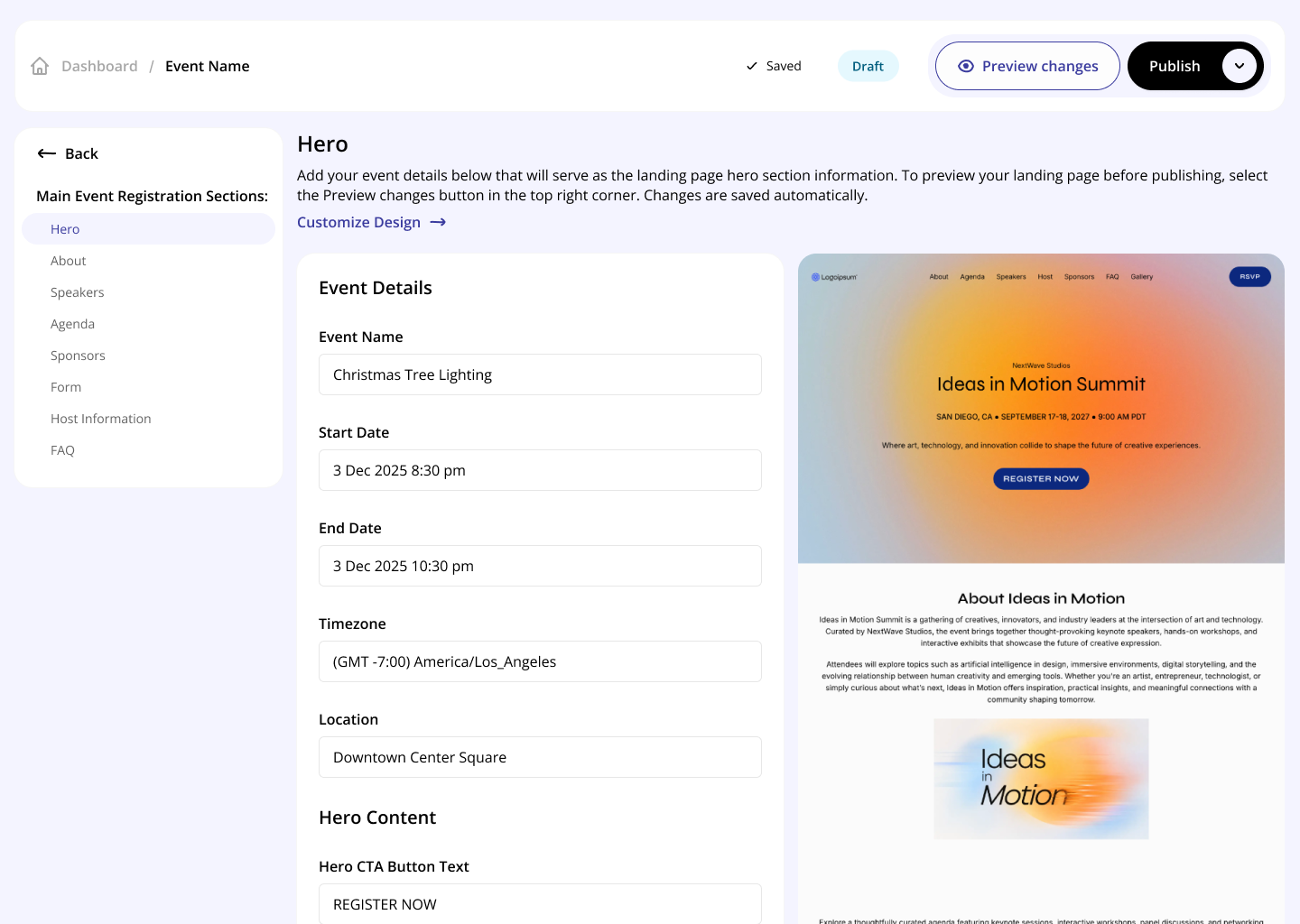
- Inferred Content Tags
- Any AI-generated content the user didn't explicitly provide is visibly tagged "inferred," with one-click edit or confirm
- Testing showed trust in the AI draft depended entirely on transparency about what was guessed vs. specified, this closed that gap directly
- Build Now vs. Guided Path Decision
- Confident users can skip straight to a generated draft ("Build Now"); less-confident users can opt into a guided question flow instead
- Testing (Part II) showed a single mandatory path either overwhelmed cautious users or slowed down confident ones
- Offering both let each group move at their own pace
Project Impact
Faster Time to Preview & Publish
Went from a blank prompt to a full generated site preview in under 90 seconds, on average
Higher Onboarding Adoption
Lifted the amount of new users that complete the setup of a event website
Reflections & Next Steps
Transparency Builds Trust in AI Output
Users didn't need the AI to be perfect. They needed to always know what it had guessed, so they could decide what to double-check.
One Path Doesn't Fit Every User
Confident and cautious users needed genuinely different flows, not just different amounts of hand-holding within the same one.
Designing for AI Structures Is Its Own Discipline
Uncertainty, confidence, and inferred content aren't edge cases in an agentic product, they're the core interaction model. This project pushed me to design for what a system doesn't know yet, not just what it does.
Thanks for stopping by, want to get in touch?
I’d love to chat and connect with you!
© Made with 💚+ 🍵︎ by Sarah Tomaszewski 2026